8.28.2013

A Trip to the A2 Wind Tunnel


Why go to the wind tunnel? 
After spending a couple days roaming around the mountains in Asheville and surrounding areas, it was now time for business...the real reason for the trip was a visit to the A2 Wind Tunnel.  So why go to a wind tunnel?  Well, science tells us that a large amount of a riders power output will go to overcome the resistance of the air, so getting in a position that minimizes drag is pretty important.  It's also important not to sacrifice power too much when getting in this optimum position.  It's a trade-off: more watts make you go faster, and less drag makes you go faster too.  If your position is super-aero but severely limits power then it may not be the best position.  If your position is very powerful but is not aero at all, it might not be the best position.  The key is finding the best of best both worlds for your optimum position.   The wind tunnel helps you do that.

How do you know if your position sucks?
Well, it's pretty tough to know without the use of a power meter.  Using power allows you to (in a controlled environment) compare average power (watts) vs. average speed (mph) to get an idea on "how much speed you are getting for your power output".  The more "aero" you are, the faster you will go off of a given wattage.

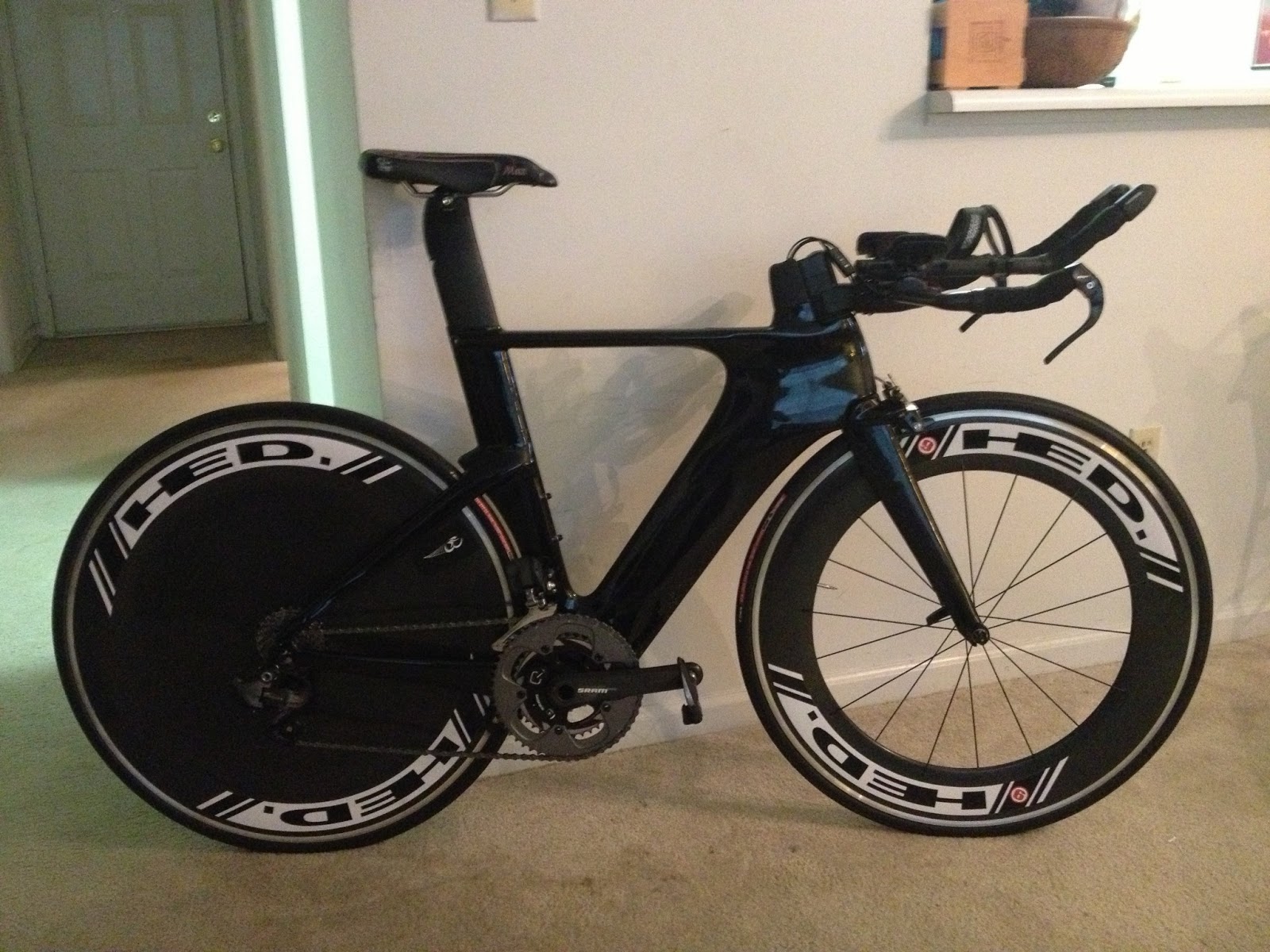
One beautiful thing about statistics is that as sample size increases you can begin to see trends.  I've been riding with power for 4 years now and since I race a lot I've got a rather large collection of power vs. speed data points in races.  Now, I'll be the first to say that you have to be careful when comparing these measures because they can be affected by things like wind and elevation, but as you increase the amount of data points you can begin to see trends and outliers.  With all this in mind, I've created the plot below from all of my races over the past 3 years.  Most of these races were on a Cervelo P2C with a Louis Garneau Superleggera helmet, and a HED Jet disc and Jet 9 with Vittoria Open Corsa EVO tires. 


Firstly, you can see two groups of data points with each group following a somewhat "up and to the right" trendline.  Obviously, this is what you would expect since it takes more power to get more speed.  What I've called "hilly" courses in the chart are races with an elevation gain rate of around 50 ft/mile or greater.  Five of these eight points are actually races on the same course.  These points are all shifted over to the left, and seemingly follow their own curve.  Over to the right you can see another group of points that consist of what I call "flatter" races.

Secondly, we can look at this chart and begin to see how terrible my time trail position is.  Lets key in on a bench mark that may cyclists and triathletes have: how many watts does it take you to go under an hour for 40k, or 24.86 mph?  Well for me, the chart says it will probably take me around 270-280 watts.  Keep in mind that I'm 5'11" tall and weigh 148 lbs.  Now how do you know if this is good or not?  Well, anyone that knows anything knows that this sucks.  But if you didn't you can do a couple things; you can see how people your size compare to you (I've got plenty of friends racing with power), you can ask coach (which I did), and you can get on forums (like Slowtwitch) and read about the vast multitudes of forum users and hear how many watts it takes them to go a certain speed.  As sample size increases you can begin to chunk some outliers and hone in on what a "good, bad, and average" power vs. speed relationship looks like.

I say all this to say that my decision to take a trip to the wind tunnel is the accumulation of knowledge and experiences over the last 4 years of training with power.  The more I trained and the more I raced, the more I realized that I was "wasting watts" somewhere.  And the faster I got, I realized that it was costing me races.  Like if I could just save 20 watts on the bike (which I thought was reasonable based on the above chart) then all of the sudden I've won 3 more races so far in 2013.

My Results
James had the session right in front of mine so I got up there early with Heath and Brian to watch his tunnel session and figure out how things worked.  You can read about his results here, but lets just say that his position was already pretty awesome and the tunnel pretty much confirmed that.  I got a lot of value out of watching his test and seeing how the guys at A2 made their decisions and ran through all the runs.  I also realized that having Health and Brian there was a very good thing, since they were providing insight and offering up suggestions based on their knowledge of James and how he rides his bike...and they would do the same for me.  Alright, enough of the pre-game, now it's time for my results.

The Baseline
The first thing you do in the tunnel is establish your baseline, as this is what all other runs will be compared to in order to determine if any position or equipment changes are "better or worse".  A2 uses a spreadsheet format that is pretty easy to understand.  The easiest thing to do is to look at "aero watts" from the spreadsheet, or the wattage to overcome aerodynamic drag.  Of course this varies with speed so for all cases we had 25 mph plugged in, as this is close to what I would average in a race.  Another note is that all of the runs were done at 0 and 10 degrees yaw.  Basically, yaw describes the idea that airflow doesn't always hit a rider head on (0 degrees) but sometimes at some other angle as determined by the wind.

As seen below, my baseline is 230 and 225 watts at 0 and 10 degrees yaw.  Basically, what this says is that to go 25 mph on my bicycle I would need to generate 230 watts plus any additional wattage required to overcome rolling resistance.  For the sake of this example we'll assume that 40 watts is a good number to assume for rolling resistance, although this depends on what kind of tires you are running.  Adding that 40 to the 230, it should take me around 270 watts to go 25 mph.  Not that the wind tunnel needs any validation (because really the tunnel is validating my previous thoughts), but this matches up pretty good with the power vs. speed chart from my last 3 years of racing.  Here is the data and side/front view from my baseline:


Position and Equipment Changes
After testing the baseline, the guys came out basically saying "yea you've got a lot of room to improve".  I expected this, and it was music to my ears.  It's also kind of obvious from the front view that my helmet is really wide, and I've got this weird lean to the right thing going on.  I'm not sure why...maybe one of my arms is shorter than the other.  One thing to note about the following test sequence is that given the current setup on my Specialized Shiv (stem slammed, Specialized proprietary stem/bars), there is no way for me to drop my front end without changing the stem and base bars.  That being said, the plan was to test a couple of other things first before moving to some new bars that would allow me to get more drop.

Pad Widths, etc
The first thing we did was play with pad widths and extension angles.  We tried moving the pads in 1 cm, 2 cm, and even out 1 cm.  We also tried angling the extensions up just a little bit.  As you can see from the table below, this didn't' change things very much.


pads in 2 cm

pads in 2 cm, extensions rotated up

Bottles
Next, we took off the bottle on my seat tube to quantify its impact, and this resulted in a 6-7 watt savings from the baseline, going from 230/225 down to 224/218.  I repeat, taking the bottle and cage off of my seat tube resulted in a savings of 7 watts!  In other words, I could now go 25 mph off of 7 less watts just by taking 30 seconds to remove a water bottle and cage.  So awesome!  We also verified that at 0 yaw the wind does not see a bottle between the aero bars, and at 10 degrees yaw I was 2 watts better without the bottle.


no more bottle on the seat tube

Helmets
After this, we tested helmets.  It was evident that my current helmet was rather wide when viewed from the front, so I wasn't going to be surprised if I found some savings here.  Given that my head is a weird shape (long from front to back, narrow from ear to ear) I had trouble fitting in most of the helmets that they had there.  The 2 helmets that I tried were the POC Tempor and the Giro Selector.  The POC was Brian's idea because based on watching me on camera he thought that the shape of it fit my contour well.  According to the tunnel guys, Giro usually tests pretty well on most people and the shape of the Selector seemed to fit me well.  As seen below, both helmets tested significantly better than my LG Superleggera, with the Giro getting the slight nod.  It resulted in massive 7-8 watt savings from the previous run!  My aero watts (at 0 and 10 degrees yaw) are now down from 230/225 at the baseline to 216/211...that's a total 14 watts...huge!


Giro Selector front view

Giro Selector side view

POC Tempor front view

POC Tempor side view

Drop
We spent the next 5 minutes or so changing the stem and base bars to an adjustable stem and Vision base bars.  This would allow me to quickly test lower positions.  We tested the front end 1 cm lower and 2 cm lower and while we didn't see any savings at 0 degrees yaw, there was a 4 watt savings at 10 degrees yaw.  I felt like anything more than 2 cm really started pinching my hips so we stopped there.


drop 2 cm front view

drop 2 cm side view

The Final Position
We started playing with extension angle again and went through a run or two with no savings.  At this point, either Heath or Brian had the idea to try me in a full praying mantis position with extensions rotated up as far as they would go...saying that just based on watching me on the computer screen it looked like it "might work out good".  Well...they were right!  This modification resulted in another 5 watt and 2 watt savings at 0 and 10 degrees yaw!  The stats are below, and the final position is #14.


Final Thoughts
In summary, I started out with a baseline of 230 and 225 watts at 0 and 10 degrees yaw and after making a couple of changes (remove seat tube bottle, new helmet, drop front end, rotate extensions) my new position ended up at 211 and 205 watts.  That's a savings of 19 and 20 watts at 25 mph.  Here is the brief summary of the changes.  I've been referring to all savings in terms of watts at 25 mph, but keep in mind that at higher speeds these savings will be even higher.


Anyone that uses power knows how massive this is!  Seeing as how it used to normally take me around 270 watts to go under an hour for 40k, the wind tunnel would suggest that I could now do it at 250 watts.  Or I could go 270 watts, which is my normal Olympic distance power output, and just go a lot faster.  Well, after 2 races with the almost new setup (I've done everything but the 2 cm drop, waiting on bars to come in), I've updated the power vs. speed plot:


You can see the two new green dots that represent the last 2 races.  Even after only two data points, it is clear that the changes have produced a faster setup.  Most notably, the far green dot to the right (273 watts, 26.2 mph) was on the same course that I raced the previous 2 years at 289 watts and 25.7 mph for both years.  I'll do the math for you.  That's 0.5 mph faster off of 16 less watts.  Free speed is awesome!

8.12.2013

Mountain Lakes Triathlon 2013

Aug 5 - Aug 11
S:  11,460 yds - 2hr 45min
B:  100.96 mi - 5hr 20min
R:  17.44 mi - 2hr 20min
Total:  10hr 15min

It's early August and that can only mean it's time for MLT.  In the wee hours of Saturday morning (4am to be exact) Lori and I headed up towards Guntersville, AL to race the Mountain Lakes Triathlon.  Firstly, I just have to say that I LOVE this race course, mainly the bike and the run.  For a sprint, the bike course is slightly longer than "normal" at 16 miles which certainly suits my strengths.  The clock-wise loop around the lake has all right-hand turns and is mostly flat with a few slight rollers that you can easily power over in your big ring, so speeds are always fast.  The run is a scenic 3 mile out-and-back on a paved running trail right along the lake.  The swim is just average though, and is advertised as 600 yards although it seems like it's always either much higher or lower than that.  The only thing I really don't like about this race is the same thing I don't like about almost every other race in the southeast; it's a time trial start.

I've done this race the last 6 years and there has defintely been a progression to faster times, as one might expect.  This is, of course, a good thing.

Year     Swim    Bike      Run       Total      Place
2008     9:18     41:32     20:31     1:13:44     52
2009     9:44     39:23     19:38     1:11:00     24
2010     7:11     40:18     19:43     1:09:03     19
2011     8:51     37:43     18:49     1:07:28       3
2012   10:22     37:47     18:09     1:08:22       5
2013     8:56     37:10     18:49     1:06:45       3

The swims are all over the board, mainly because the swim is different every year.  If I were RD I would actually measure the swim.  How hard could it be?  Not very.  2008 through 2010 were my learning years, and then all of the sudden 3 full years of consistent training started paying off and my times started dropping.  One other interesting note is the bike splits.  2011 and 2012 showed practically the exact same splits, which makes sense because my average power was pretty much exactly the same in both races.  This summer I've done some work on my position and even made a trip to the soon-to-be-blogged about A2 Wind Tunnel.  The conclusion of the trip was that my helmet sucked pretty bad and I made a few other changes to optimize my position.  The result...drum rolllll...is what you see in the chart below for the years of 2010-2013 at the Mountain Lakes Triathlon bike course. 


That's 26.15 mph off of 273 watts compared to about 25.7 mph off of 289 watts the previous 2 years.  So basically I went 0.42 mph faster off of 16 less watts...got to love free speed!  To give another idea on how huge this is and how much physiological difference 16 watts makes when you are near threshold, so far throughout all of my rides in 2013 my duration for a mean maximal power of 289 watts is about 63 minutes and my duration for a mean maximal power of 273 watts is 93 minutes.  So as power increases by just 5% from 273 to 289, the duration that I can maintain said power decreases by 32%. 

Anyways...going faster off of less is always a good thing.  Now enough with the analysis...I just got excited for a little bit.  Here's how the race played out.   

Swim - 8:56 (13th)
I was the 9th racer to start in time trail fashion.  Andrew Hodges was the first racer to start and I knew he would be tough to beat...it would basically take the bike of all bikes to overcome the swimming and running deficit that he would put into me.  I was also surrounded by a bunch of kids from the Southeast Junior team...most of them are pretty good swimmer/runners so you can't take them all for granted.  As I went off I tried to find some feet to catch and just swam as hard as I could.  I exited the water right with Lori who started 30 seconds behind me so I felt pretty good about that.

T1 - 1:15 (30th)
Ok, I'm just going to say it...this was terrible.  I think it's because the straps on my new helmet have smaller buckles or something because I fumbled around for what seemed like 15 seconds with it.  Crap!  In a sprint race this can easily be the difference between winning and losing so I was not happy about that.  I finally got it buckled and was off to catch some bikers.

Bike - 37:10 (1st)
I knew I had my work cut out for me here, figuring there were 5-10 people out on the course in front of me.  Trying to settle into a sprint distance bike is tough because you don't want to blow up in the first 10 minutes but you don't want to leave anything on the table either.  After a few minutes I found my sweet spot and just tried to keep the power output steady from there.  From there I passed 6 or 7 people in the first 5 or 6 miles before the roads became empty.  At this point I thought that Andrew was the only one in front of me.  Somewhere around mile 10 or so I came upon a rider who I knew wasn't Andrew and it turned out to be a relay racer, but with a few miles to go I finally caught sight of him up the road.  With about a half mile or so to go I made the pass, thinking that I was first in off the bike and sitting in the virtual lead of the race.  However, after rolling into transition I noticed that there was one bike on the rack, so one of the kids must have been having a good race. 

T2 - 0:37 (26th)
No mistakes here, just a quick in and out.

Run - 18:49 (11th)
As I started the run Andrew couldn't have been more than 10-20 seconds behind me, if that.  Sure enough he came flying by me a minute or two in and there was nothing I can do.  It was hot but more than that it was super humid, and I was struggling with 6 to 6:30 pace.  From what I could tell there was no one close behind but I knew that Jeffrey Shelley had started a good bit behind and we would be close.  At the turnaround I could see the leader (some 15 year old kid) and Andrew not far behind him.  The rest of the run I just tried to focus on not blowing up and staying strong.  It was nice to see familiar faces on the way back in, and with a slight negative grade on the return trip it made it that much better.

Total - 1:06:45 (3rd overall)
I knew I was 3rd across the line but only time would tell if that would hold up.  As it turns out, Jeffrey finished a mere 5 seconds behind me so I was able to secure 3rd overall.  He later got hit with a bogus 2 minute drafting penalty that was likely some sort of mix-up.  I think that makes me 2-2 against him this year...it's always a hard fought battle.  At the end of the day I was pleased with the race although I know I can still run faster.  It's just hard to execute everything perfectly in this Alabama heat and humidity!  Also...huge props to Lori for winning the overall female race by a good 2 minutes...in only her 4th triathlon ever! 

overall podium, Lori got the win!

8.08.2013

River Cities Triathlon 2013

July 22 - July 28
S:  12,101 yds - 2hr 48min
B:  197.03 mi - 9hr 27min
R:  28.57 mi - 3hr 37min
Total: 15hr 52min

July 29 - Aug 4
S:  11,827 yds - 2hr 52min
B:  95.50 mi - 4hr 59min
R:  27.04 mi - 3hr 29min
Total: 11hr 20min

It's really hard to not do all the local races around and near Alabama every year, but sometimes that gets old.  When Lori mentioned traveling to Shreveport, LA to do the River Cities Triathlon and to visit her Alma mater (Centenary College of Louisiana), I was pumped!  We headed out on Saturday morning to start the 7 hour trek over to Shreveport.  Local triathlete Jennifer Christy grew up in Shreveport and her parents graciously put 7 of us up in their house.  Jennifer's husband Micah made the trip as well; props to him for snapping a handful of superb pictures during the race.

The next morning we awoke early for our breakfast routine and then made the 40 minute drive to the race site, which was based in some sort of a park.  With the race being a sprint (0.5 mile, 18 mile, 5k), I wanted to make sure I was nice and warmed up.  Lori and I went for a 2 mile run with some striders and it was at that point that I knew it was going to be a brutal day.  It was already getting kind of hot and the humidity was BRUTAL.  Usually this would be no problem, but summer in Alabama has been somewhat mild this year so this was a complete shock to the body.  Anyways, here's how the race went.

Swim - 12:52 (7th)
I lined up with 21 other guys in the elite/invitational wave.  The swim course was a 0.5 mile clockwise triangle so I positioned myself on the right hand side on the 2nd row.  As the gun sounded, we-took off.  The pace was high for the first 100 meters but I found myself still in the pack.  At this point things spread out and I could see 1 guy out front and handful of others in front of me, but it was hard to tell how many.  Everyone else was behind so I just focused on swimming hard and swimming straight.  The rest of the swim was uneventful and I thought it went pretty well, although I didn't have much clue on my position.

swim exit...hurting pretty good

T1 - 1:19 (13th)
T1 went smoothly.  My new helmet takes slightly longer to put on (it's a snug fit) but probably only by 5 seconds or so...nothing substantial.  13th sounds terrible but most of us were in the 1:10 to 1:20 range.

Bike - 43:12 (7th)
The bike was interesting.  This was my first ride with a new helmet that has less venting.  This was also the 2nd ride on my new bike setup, which basically has me in a praying mantis position with extensions rotated up 25 degrees.  It still feels somewhat awkward but I'm getting used to it.  That being said, the first thing that I noticed out on the bike was that it was very hot and my heart rate was very high (and not coming down as quick as I wanted).  As I spent the first few minutes settling into the effort, it became apparent that my wattage was going to be lower than normal.  Oh well, some days are like that.  I managed to pass 1 guy within the first few minutes and 2 others at about the halfway point.  From there on I was completely solo for this 18 mile clockwise loop course so I just focused on a high and steady effort.  I came off the bike in 4th place, but keep in mind that I had absolutely no clue what position I was in.  This would have been nice to know!

new helmet, new setup

finishing the bike

T2 - 1:20 (15th)
I spent about 5-10 seconds fumbling with a shoe but other than that, no issues here.  We had to run a loop in transition before getting out on the course.

Run - 20:07 (7th)
This is where it gets even more interesting.  The run was a semi out-and-back, but on the return trip the course took several "diversions".  This would prove to make it very difficult to gauge what position I was in.  Post-race analysis told me I started the run in 4th but I had no clue and throughout the race I did not see a single person on the return trip.  At that point it was so hot that I was in survival mode anyways, so it probably would not have mattered.  As soon as I came out of T2 I knew it was going to be a suffer fest.  My head was on fire and my ears were slightly "stopped up", which seems to happen to me when I start to overheat.  A couple minutes into the run, two guys came by me running substantially faster than myself.  I was struggling with 6:30 pace and they flew by me.  Crap.  Mile 1 was a 6:30...not going to cut it but it was the best I could do.  I told myself to suck it up and I cranked up the pace a little bit.  Two other guys passed me but I passed two more so I'm sitting in 6th.  Mile 2 was a 6:13 and I was overheating bad!  At about the 14 minute mark, my whole stomach started to cramp up...it was weird...almost like a side stitch...but my whole stomach.  I tried to carry on but the pain was unbearable to I started to walk.  This was such a terrible feeling, especially when I got passed by another guy, moving me into 7th.  After about 30 seconds of walking I gradually started running again and was able to pick the pace up a little bit and finish at a decent clip.

rounding the corner to the finish...


...ready for this thing to be over!

let's play "where did Chad start walking?"

Total: 1:18:52.6 (7th overall)
In the end I didn't have a bad race, but I didn't have a good race either.  I thought I swam well but my bike and run left a little bit to be desired.  Bike watts were at least 30-35 watts lower than normal for a sprint, and my 5k was at least 1.5-2 minutes slower than what I've done earlier this year.  If you shaved 2 to 2.5 minutes off my time I would have been right when 2nd and 3rd place.  It's crazy what a big difference a minute or two can make, it certainly emphasizes the importance of execution on race day!  The big question is how much of this was due to the heat?  All of it?  It was hot, and by hot I mean way hotter and more humid than it's ever been in Alabama this year.  You certainly can't discount that.  At the end of the day, however, I'm happy because I know I went as hard as I could and could not have gone any faster.  It's unexplainable, but some days you have it and some days you don't...and today I did not quite have the top end speed.  Many thanks to Jennifer Christy for putting us up in her parents house.  Jennifer had a solid race herself, finishing 2nd place in the female masters category.  And of course, congrats to Lori who finished 3rd overall female in her 3rd triathlon ever!  What a stud!

post race, Lori got 3rd overall!

7.25.2013

Chattanooga Waterfront Duathlon Race Report

July 8 - July 14
S:  15,791 yds - 3hr 39min
B:  124.89 mi - 6hr 44min
R:  28.38 mi - 3hr 33min
Total:  13hr 57min

July 15 - July 21
S:  10,134 yds - 2hr 32min
B:  154.21 mi - 9hr 2min
R:  18.38 mi - 2hr 30min
Total:  14hr 5min

I've come to realize that I have a love/hate relationship with the Chattanooga Waterfront Triathlon.  This race usually falls around mid-July, and anyone that lives in the southeastern United States knows that July is about as miserably hot as it can get.  The Chattanooga course is wide open on the bike, so if it's hot then you absolutely cook.  The run is somewhat shaded but is right on the water so the humidity seems to really skyrocket on the course.  Add in a decent hill at the start/end of the run and it's a recipe for suffering.  This would be my 6th year in a row to do this race, and it's pretty much 50/50 as to whether I'll have a decent race or not.  I usually pride myself in being able to execute most races pretty well, but this course has historically been the exception.  I even vowed last year to never do this race again!  Ha!  But Chattanooga is just an awesome city, so it's really hard to turn down this quick 2.5 hour drive for some good racing and good competition.

This year's race brought some unexpected changes.  Chattanooga saw record rainfall the week before the race, so on Tuesday of race week we all received an e-mail informing us that the swim would likely be canceled.  Both the swim start and finish docks were completely underwater, so there was pretty much no other option.  The swim would be replaced by a 2 mile run and the rest of the race would proceed as normally planned.  So...on Saturday Lori and I drove up and headed straight to packet pick-up.  Lori was signed up for the aqua bike but with a swim cancellation she opted for a credit to another race.  Next, we headed to Lupi's with Hallie and Lee/Heather Simms for some pizza...probably my favorite pre-race meal.  Luckily we made it right before the crowd and were able to eat and get back to fix up our rides and get some sleep!

pre-race

Rain was in the forecast but luckily it stopped about an hour or two before the race.  We biked down to the race site from the hotel, as it was only about a mile away.  The day was shaping up nicely in terms of conditions...the rain was gone, the sky was cloudy, and temps were actually somewhat low (70-80's)...a recipe for a good race!  Here's how it went:

Run 1 (2mile): 11:48
Unfortunately, even after this race was turned into a duathlon it was still a time trial start.  I was the 21st racer off the line and quickly settled into a very comfortably hard pace.  I was thinking I'd probably settle in around 5:50 pace and that's exactly what happened.  Jeffrey Shelley started a couple numbers behind me and quickly bridged up to me, and then we stayed together for the rest of the run.  I knew we would be dead even for most of the race so staying with him was crucial.

Leading Jeffrey into T1

T1: 1:06
Usually T1 is pretty fast and uneventful, but I really screwed this one up.  I *thought* that we were supposed to run out the far back corner of transition but as it turns out, that was not the case.  Since transition was rather large (this race had close to 1,000 people in it) this cost me a decent chunk of time.  Jeffrey exited T1 23 seconds faster than me...crap!!  I saw him up the road and could just not believe how stupid of a mistake I had just made.  It really only cost me 1 position in the overall but it was still a huge screw-up.

Bike (42k): 1:04:09
The bike course was somewhat hilly so I had a plan of upping the watts slightly on the climbs and backing off slightly once up to speed on the descents.  I came out of transition close to Bruce Gennari  and we traded off back and forth for at least the first 10-15 miles.  It was good to have him near me for some motivation.  Watts felt good, and I found myself wanting to hover around the 270-280 mark with a slight increase/decrease on the climbs/descents.  I could see Jeffrey up in front of me at the turnaround and we were practically dead even.  I finally got away from Bruce and reeled in one other guy, who then passed me back as we rolled the last few miles.  Coming into T2, I knew I 'd have to lay down a good run to catch Jeffrey and the other guys up the road.

T2: 0:58
No mistakes here, thankfully.

Run 2 (10k): 38:39
The run starts off with a hill and after learning from my past mistakes I eased into the first mile.  After a slower mile 1, I clicked off a 6:13 and 6:16 before nearing the turnaround.  The leader was 5 minutes ahead and Jeffrey was a probably 1.5 minutes...probably too much to catch but I would certainly try.  Mile 4-5 were 6:14 and 6:18 before hitting the final mile and one last hill before the finishing sprint.  Alex Solomon came around me with 200 meters to go and we had a nice little sprint but he edged me at the line...not that it mattered because he started behind me anyways.

the final sprint

Total: 1:56:38 (9th overall, 3rd AG)
All in all, this was an excellent race.  Both runs were executed well, and considering I wanted to quit about 5k into the 2nd run I'm happy about that.  As it turned out, this was actually my fastest 10k run ever in a triathlon so that's certainly a good thing.  The bike was my fastest time at Chattanooga my about 1.5 minutes, which is massive!  The only mistake I made was in T1, which cost me an overall spot and an age group spot.  *But*...if I had not made this mistake I would have started the 10k run with Jeffrey and would have been in a head-to-head race with him to the line.  Oh well...you race, you learn...I just can't make that mistake again.

7.09.2013

Peavine Falls Race Report

July 1 - July 7
S:  15,680 yd - 3hr 40min
B:  194.18 mi - 11hr 26min
R:  45.15 mi - 5hr 56min
Total:  21hr 2min

Two records this week...biggest weekly hours and longest bike ride!  Having a holiday weekend with nothing to do but drink coffee/beer, watch the Tour, eat, nap, and sleep 10 hrs/night does wonders for recovery.  And on top of that I managed to get a race in too.  The Peavine Falls Run is held every 4th of July in Birmingham at Oak Mountain State Park.  It's a tough 8.2 mile course, climbing 3.5 miles to the top of Peavine Falls at ~1100 ft before turning around and descending back to the start line...finishing up with ~1.2 miles on some nice single track trail.  Having never done this race before I felt obligated to throw my name in the hat.  The main goal was to get a top 10 finish.  Race conditions were actually quite nice.  As it is usually 100 degrees this time of year, 75 degrees and pouring rain was kind of nice, although it would make for an interesting end to the race on the trail.

The race started off like all races do; everyone tries to see how they can manage to blow themselves up in the first 2 minutes of the race.  As Brian says, "proper pacing is proper racing".  I ran the first mile in 6:28 and I swear there were at least 25 people in front of me.  By mile 1.5 I watched about 10-15 spectacular blow-ups and had moved myself up to around 10th or 11th place.  I found myself in a group of 4 for the remainder of the climb before gapping them slightly just before the top.  At the turnaround I could see that I was in 7th place.

The descent back down the mountain was FUN!  I was afraid to look behind me because I knew I had a few guys on my heels so I just tried to push it as hard as I could.  Near the end of the descent I was passed by 2 guys right before hopping on the single track trail section.  The trail section was sketch.  I got gapped a little bit and was hurting bad...the trail was slick, muddy, rocky, and rooty, and it was all I could do to just stay upright.  I was now sitting in 10th place and also had Elena Linn right on my heels.  Great, now I might have to sprint for the finish line to a) not get chicked and b) attain a top 10 finish.  Luckily, I moved away somewhere near the end of the trail and crossed the line in 53:23, good for a 10th place finish, whew!  Despite the rainy conditions, it was a record turnout.  Thanks to all the RD for organizing this awesome race and thanks to all the volunteers for standing out in the rain all morning!

overall results
  

7.08.2013

1609m

Jun 10 - Jun 30
S:  38,772 yd - 8hr 57min
B:  367.45 mi - 21hr 16min
R: 95.05 mi - 12hr 21min
Total:  42hr 34min

As long as I have been seriously training, I've always thought about running one mile, full gas, on a track, for time.  These thoughts have never been put into action, until now.  As an at-large board member of the local triathlon club (Vulcan Triathletes), I came up with the idea of doing a bike and run time trial series this summer.  The series consists of 2 bikes and 2 run; and yes, to satisfy my own selfish desires, one of these runs was a 1 mile track race!  This may sound pretty boring, but I was pumped.  My training and racing this year suggested I MIGHT be able to crack the 5 minute barrier, but predictions and actuality are two completely different things.  Nonetheless, I was going to give it my best shot.

For those that don't know, and I'm always surprised at how true this is, a mile is 1609 meters (not 1600).  So, 4 laps around a 400 meter track + an extra 9 meters.  My normal track does not have the 1 mile line marked so we just stood 1 meter in front of the 110 meter line, which is 10 meters behind the start/finish line.

And now, for the shortest ever "race report".  There were only 4 of us participating.  Jeremy Clark was a collegiate runner and said he would do his best to keep me on track for a sub 5.  We took off and before I knew it we had blown through the first quarter (plus the extra 9 meters) in 73 seconds.  On lap 2 I was feeling good but things were starting to hurt.  I glanced down at the halfway point and saw 2:26; still on track.  The third lap was tough; my arms were getting tight and my legs were burning...but it passed by still on track.  At this point I knew I had it but this didn't make the last lap any less excruciating.  With a final "sprint" I crossed the line in 4:58.2...success!!

"the proof"
   

6.09.2013

Buster Britton Triathlon Race Report

June 3 - June 9
S:  9,250 yds - 2hr 9min
B:  57.20 mi - 3hr 8min
R:  22.06mi - 2hr 49min
Total:  8hr 5min

I've raced the Buster Britton Triathlon every year since 2008, and this year was no different.  Oak Mountain State Park is about 15-20 minutes from my house, so it really is hard to turn down a sprint race in my own backyard, allowing me to sleep in my own bed the night before!  Local races are also cool because everyone usually does them, so it's great to see tons of friends at the race site!

Anyone from Birmingham knows that Oak Mountain is pretty hilly.  The 13 mile bike course is either uphill or downhill, with essentially no flat sections.  Almost 800 ft of climbing in 13 miles may not seem like much, but there are several steeper sections (by triathlon race standards) that can really slow you down.  The 3 mile run course is also pretty brutal, climbing 300 ft over the distance.

Now, let's look back at my history at Buster Britton.  The last 6 years of this race have brought plenty of memories, both good and bad.  2008 - 2010 were my "learning years".  I made some big time gains from 2008 to 2009.  I can remember 2010 being one of the most awful races ever.  2010 was a brutal hot summer in Alabama, and I had just been sick the week before the race so I absolutely blew it.  Learning years = high variability in execution.

Buster 2011 was my first ever overall win in a triathlon, barely edging local stud David Meadows by 7 seconds for the victory.  I'll never forget that day.  Buster 2012 was one of those bad memories.  Going head to head with Aaron Ainsworth always brings out the best in you.  I had a great race and unoffficially took 2nd place until I found out at the awards ceremony that I had been hit with a 2 minute position penalty on the bike.  I was at the front of the race during the bike but was told that I got a position foul for not staying in the right hand 1/3 of the lane.  I still disagree with this call.  To add on to the bad news from this race, I had already found out that one of my best friends, who was participating in the race, lost control on a 40mph descent and slid into an oncoming car.  He suffered some serious injuries but has since recovered.  Still, note the steady improvement of times over the years with the exception of 2010 and the penalty in 2012.  Consistency, time, steady, plan, improvement, and process are all words that come to mind here.

Year      Place     Time
2008     61           1:12:20
2009     23           1:03:21
2010     24           1:07:22
2011     1                59:45
2012     9             1:01:29 (59:29 for 2nd , then got a 2:00 penalty)
2013     4                58:11

And now, for 2013.  After checking the participant list early in the week, I was pretty sure the race would come down to 5 people (Seth, Hunter, Jeffrey, Ben, and I).  I figured that Seth Rider and Hunter Honeycutt (SE Junior Team) would be tough to beat.  I raced against Seth twice at Memphis in May this year and he tore it up.  For a 16 year old the dude is quick, going 1:59:06 for 2nd overall in the olympic distance there.  Hunter Honeycutt (from my memory) would probably lay down a 16min 5k.  Both of these guys are stud swimmers as well.  I've raced and trained with Jeffrey Shelley enough over the last 3 years to respect his talent.  It's rare that we race each other with a margin of more than 30 seconds.  Ben Reynolds barely edged me this past April by a mere 10 seconds over a 2hr race, so I knew he would be bringing his A game.  On race morning I ran into Bruce Gennari in the parking lot...I had not seen his name on the participant list.  Anyone that races tri in the southeast knows Bruce, and you can obviously never take him for granted.  All that being said, I knew that this race would allow for zero mistakes.  The high school kids would likely put time on me in the swim, so I figured my best chance was to bike hard and hold on for dear life. 

Swim - 5:55 (22nd)
The swim was advertised as 400 yd but was probably closer to 450.  I was the 15th racer to go off in the time trail start.  The USAT Southeast Junior High Performance Team was in full force at this race and I was stuck in the middle of them.  Most of these kids swim year round and could probably swim circles around me so my plan was to just try and grab as many feet as possible.  The swim went well and a hair under 6 minutes later I was running up to transition.

T1 - 1:29 (18th)
Smooth and quick, no mistakes here.  Every second counts.

Bike - 32:40 (4th)
The bike is where I knew this race had to be won, so my plan was to be aggressive.  The first mile of the race is flat/downhill before turning on the main road so I used that section to let my heart settle down a little bit.  After hitting the main road I started to hammer.  By the halfway point I had passed a handful of the junior guys and saw that only Bruce, Seth, and Hunter were in front of me.  I could see Seth off the front with a decent gap.  On the return trip I focused on maintaining power and reeling in Bruce and Hunter.  I passed Bruce with mile to go and then passed Hunter about a quarter mile from transition.

first race on the new machine!

T2 - 0:22 (6th)
No mistakes here either...just a quick in and out.

Run - 17:47 (10th)
The first quarter mile of the run is uphill, which really sucks.  It makes it even harder to find your rhythm and get your leg turnover up.  Hunter quickly passed me and went on to run 16:14.  I struggled up the hill and was worried that I might have blown myself up.  But as we crested the hill and turned downhill, I found my legs.  Mile 1 went by and I was hurting bad but still maintaining pace pretty well.  Mile 2 was more of the same and I saw that my gap on Jeffrey Shelley was less than desirable.  He started 11 numbers behind me (30-40 sec) and was too close for comfort.  The last mile gives you a nice little downhill and I sprinted it in, knowing that the time gaps would be close.

Total - 58:11 (4th overall)
After they posted results I saw that Jeffrey edged me by 23 seconds, with Seth and Hunter taking the top 2 spots.  It always stings a little bit to narrowly miss the overall podium, but I was 100% sure that I went as hard as I could and left it all out on the course.  Some days you just have to tip your hat to the better athlete, and this was one of those days.  But today had plenty of positives; it was my fastest run and fastest time ever at Buster Britton, and I did get a pretty nice swag bag for 1st in the age group.  Buster Britton is always a fun race, no matter what!

post race Vulcan Tri club group photo!